For a while, Wan 2.6 felt like the sweet spot.
It was fast enough, cinematic enough, and — most importantly — predictable enough that creators could actually build workflows around it. You could throw together a decent prompt, generate a few clips, stitch them together in Premiere, and end up with something publishable in under an hour.
That’s why so many AI filmmakers, TikTok editors, and solo creators quietly adopted it. Not because it was perfect, but because it was usable.
Then Wan 2.7 arrived.
And instead of giving creators “Wan 2.6, but better,” Alibaba released something far more ambitious — and far more divisive. Wan 2.7 doesn’t feel like a normal model update. It feels like a shift in philosophy.
After spending two weekends testing roughly 40 prompts across both models — mostly cinematic prompts, reference-to-video workflows, short narrative scenes, and character consistency tests — one thing became obvious:
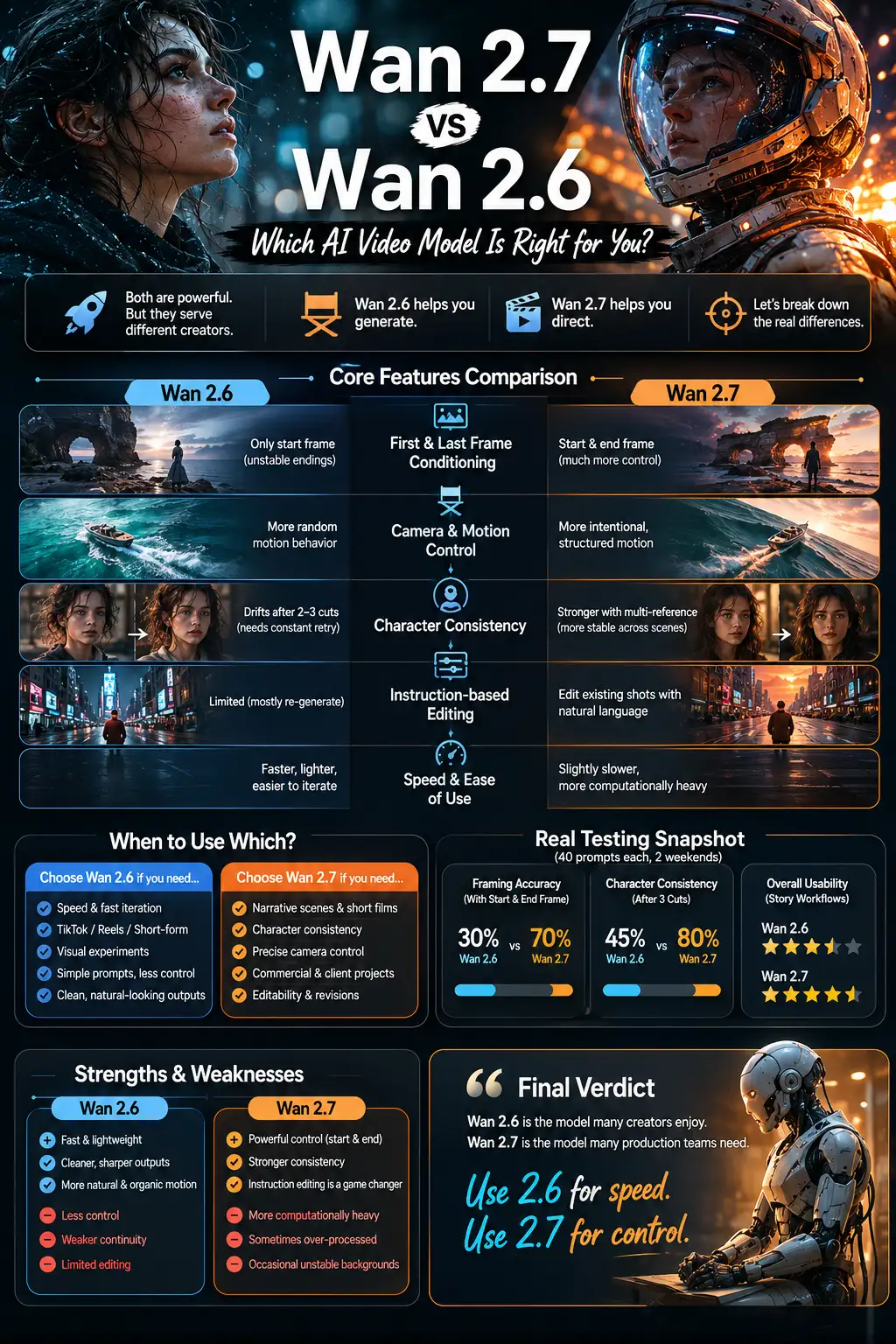
Wan 2.6 wants to help you generate videos.
Wan 2.7 wants to help you direct them.
That sounds like a small distinction. It really isn’t.
Why Creators Fell in Love With Wan 2.6
To understand the mixed reaction around Wan 2.7, you first have to understand why Wan 2.6 became so popular in the first place.
Wan 2.6 hit a very unusual balance.
It wasn’t the smartest model. It wasn’t the most controllable. And honestly, it wasn’t even the most technically impressive once newer systems started appearing.
But it consistently produced clips that looked surprisingly good with surprisingly little effort.
And in AI video, that matters more than people admit.
A lot of creators don’t actually want a complicated production pipeline. They want speed. Momentum. Iteration. They want to try five ideas in twenty minutes without fighting the model every step of the way.
Wan 2.6 was good at staying out of your way.
The motion usually felt natural. Lighting stayed relatively stable. Faces held together better than expected for short sequences. Even the lip sync — while far from perfect — was usable often enough that creators could build around its limitations instead of constantly troubleshooting them.
More importantly, Wan 2.6 had a certain aesthetic softness that made clips instantly social-media friendly. It tended to flatter scenes. Sometimes almost too much.
That made it addictive.
Wan 2.7 Changes the Relationship Between Creator and Model
Wan 2.7 is technically more advanced in almost every meaningful category.
But it also asks more from the creator.
That’s where a lot of the online frustration comes from.
People expected Wan 2.7 to feel like:
“Wan 2.6 with cleaner visuals.”
Instead, it behaves more like:
“A controllable AI filmmaking system.”
Those are completely different experiences.
The Biggest Upgrade Isn’t Visual Quality
It’s control.
More specifically: first-frame and last-frame conditioning.
This feature alone changes how scenes can be designed.
In Wan 2.6, you usually gave the model a starting image and hoped the motion evolved in a coherent direction. Sometimes it did. Sometimes it absolutely did not.
If you wanted:
- a slow push-in shot
- a cinematic reveal
- a character ending on a close-up
- a drone-style transition
you were basically negotiating with probability.
Wan 2.7 changes that dynamic.
Now you can define where the shot begins and where it ends. The difference sounds minor until you actually start building sequences with it.
During testing, I used a simple prompt repeatedly:
“A woman walks toward camera and ends in a medium close-up.”
With Wan 2.6, usable framing happened maybe 3 out of 10 generations. Sometimes the camera drifted sideways. Sometimes the framing overshot entirely. Once, bizarrely, the model turned the shot into a semi-orbiting cinematic pan that looked visually impressive but ignored the prompt completely.
Wan 2.7 was noticeably more reliable once first and last frame guidance were introduced. Not perfect — the model still occasionally overcommits to dramatic motion — but much easier to steer intentionally.
That distinction matters if you’re trying to build scenes instead of isolated clips.
Wan 2.7 Thinks More Like a Director
This is harder to explain until you actually spend time with both systems.
Wan 2.6 generates motion.
Wan 2.7 appears to plan motion.
The camera behavior feels more deliberate. Transitions feel more structured. The pacing feels less chaotic.
Not always better, interestingly. Just more intentional.
There were moments during testing where Wan 2.7 produced technically “superior” shots that somehow felt less alive than Wan 2.6 outputs. The newer model sometimes pushes cinematic interpretation so aggressively that scenes lose a bit of spontaneity.
But for narrative workflows, the tradeoff usually makes sense.
Especially once multiple shots are involved.
Character Consistency Finally Starts Becoming Real
One of the biggest frustrations in AI filmmaking has always been continuity.
A character looks perfect in one shot.
Then suddenly:
- different jawline
- different eyes
- different hairstyle
- slightly different person altogether
Wan 2.6 handled this better than many competitors, but identity drift still became obvious once scenes extended beyond a few cuts.
Wan 2.7 makes a serious attempt to solve this with expanded multi-reference conditioning.
And honestly, this is where the upgrade starts feeling genuinely important.
In my testing, Wan 2.6 usually began drifting facial identity after the second or third scene transition, especially in reference-to-video workflows. Wan 2.7 remained noticeably more stable once multiple references were introduced.
Not flawless. Still not production-grade in the Hollywood sense. But finally usable enough that creators can start thinking in sequences instead of isolated hero shots.
For AI short filmmakers, that changes everything.
The Most Underrated Feature Is Instruction Editing
Ironically, the feature that may matter most commercially is the one people talk about the least.
Instruction-based editing.
This is where Wan 2.7 quietly stops behaving like a generator and starts behaving more like production infrastructure.
Instead of regenerating an entire sequence because a client wants:
- darker lighting
- different wardrobe colors
- sunset instead of daytime
- another background
you can modify the existing result directly.
That sounds incremental until you’ve dealt with real client revisions.
A lot of people still think AI video is mainly about generating cool clips. But commercial production is usually less about generation and more about iteration.
Clients change their minds constantly. Creative direction shifts midway through projects. Brands ask for tiny revisions that somehow require rebuilding entire scenes.
Wan 2.7 feels designed for that reality.
And Yet... Many Creators Still Prefer Wan 2.6
This is where things get interesting.
Despite all the technical improvements, a surprisingly large number of creators still prefer Wan 2.6.
Not because it’s objectively superior.
Because it often feels better.
That distinction matters more than benchmark culture likes to admit.
Many creators describe Wan 2.6 outputs as:
- cleaner
- sharper
- less overprocessed
- more cinematic
- more “alive”
Criticism of Wan 2.7 tends to focus on:
- graininess
- artificial textures
- unstable backgrounds
- overcommitted motion interpretation
And honestly? Some of those criticisms are fair.
In several of my own tests, Wan 2.7 occasionally felt almost too cinematic. The model sometimes forces dramatic camera movement into scenes that would actually benefit from restraint.
Wan 2.6, oddly enough, can feel more natural precisely because it’s less ambitious.
That’s one of the strange tensions emerging across modern generative video systems: more control does not automatically create more realism.
Sometimes it creates the opposite.
The Community Split Actually Makes Sense
The Wan 2.6 vs Wan 2.7 debate is really a debate about what creators value most.
Some creators prioritize:
- speed
- aesthetics
- simplicity
- fast iteration
- organic-looking motion
Others prioritize:
- control
- continuity
- editability
- production reliability
- multi-scene workflows
Those groups are solving completely different problems.
Which is why they keep arguing past each other online.
Which One Is Actually Better?
The frustrating answer is: it depends on what kind of creator you are.
If you mainly create:
- TikTok edits
- AI reels
- visual experiments
- short-form social content
- rapid concept tests
Wan 2.6 still feels fantastic.
It’s responsive. Lightweight. Easy to improvise with. You can move quickly without overthinking every shot.
But if you’re building:
- narrative scenes
- AI short films
- ad campaigns
- character-driven sequences
- commercial production pipelines
Wan 2.7 is clearly more capable.
Not necessarily prettier.
But more usable at scale.
And that distinction is becoming increasingly important as AI video matures.
The Real Story Behind Wan 2.7
Wan 2.7 is not trying to win the “best-looking single clip” competition.
It’s trying to become infrastructure.
That’s the bigger story here.
The AI video industry is slowly moving away from novelty generation and toward controllable production systems.
The future probably belongs to models that can:
- maintain characters
- preserve continuity
- edit scenes
- understand shot structure
- support revisions
- collaborate with creators instead of replacing them
Wan 2.7 feels like Alibaba recognizing that shift earlier than most people expected.
Final Thoughts
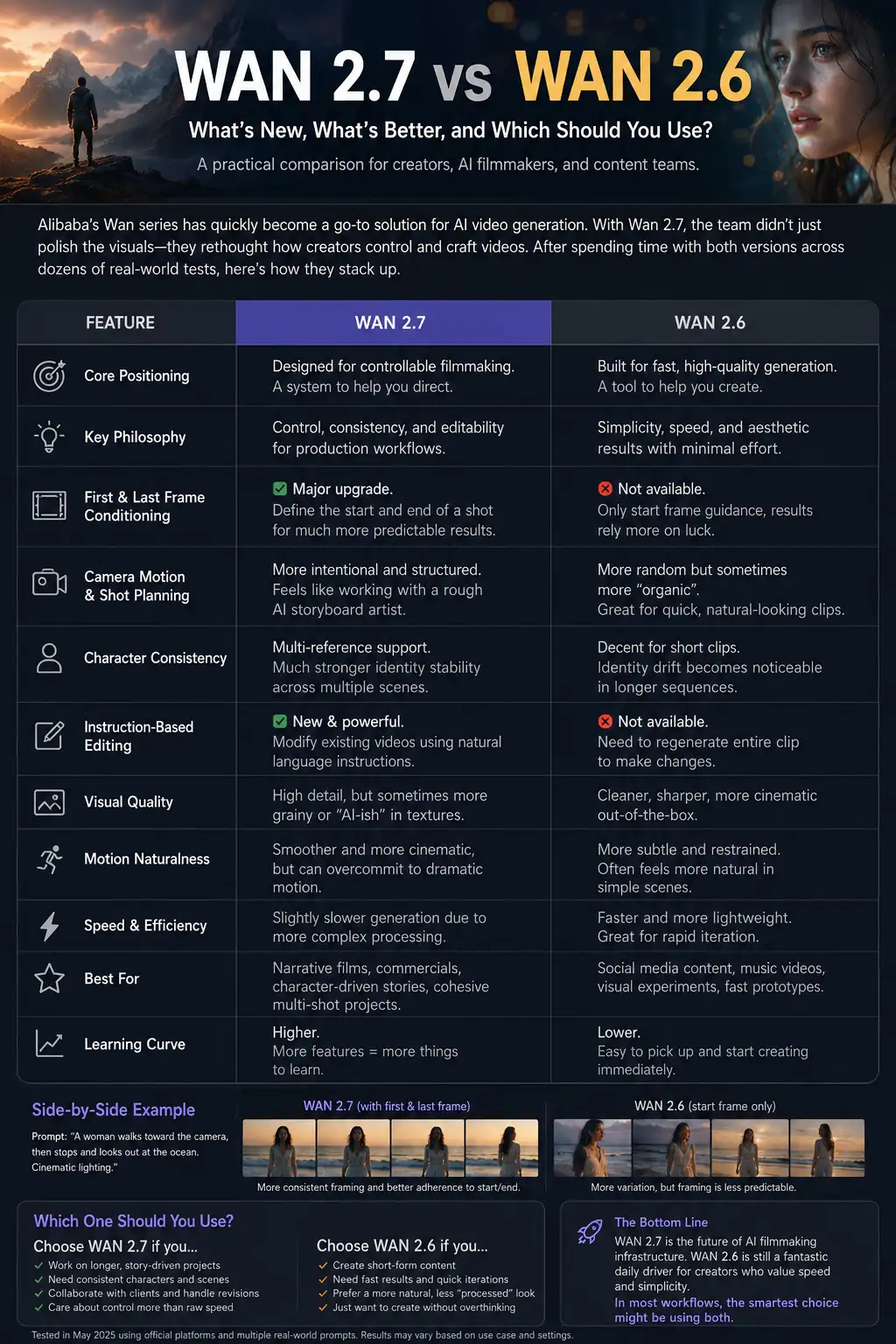
Wan 2.6 is the model many creators genuinely enjoy using.
Wan 2.7 is the model many production teams may eventually need.
Right now, the smartest creators are not choosing one over the other. They’re using both.
Wan 2.6 for speed and exploration.
Wan 2.7 for structure and control.
And honestly, that might be the clearest sign yet that AI video generation is finally growing up.